LDL Cholesterol
LDL
- Sample
- Blood
- Usual units
- mg/dL
- Fasting
- Usually done fasting. Follow the fasting instructions your lab or doctor gives you.
Also known as LDL · LDL-C · Low Density Lipoprotein · LDL Cholesterol Direct
What this test measures
LDL cholesterol is the cholesterol carried in low-density lipoprotein particles, one of several particle types that carry cholesterol through the bloodstream. A lab measures it separately from HDL and total cholesterol because the different particle types are read differently, and reporting them individually gives a fuller lipid picture than a single combined number. It is usually reported in milligrams per deciliter (mg/dL).
Reading your report
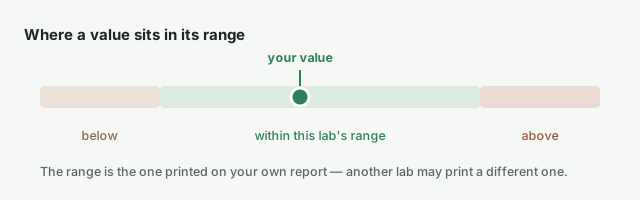
There isn’t one standard range for this test — each lab prints its own. Use the range shown next to your result.
LDL Cholesterol unit converter
Convert LDL Cholesterol units
Labs print this test in mg/dL or mmol/L depending on where the sample was run.
Related guides
- Guide
Why the same blood test has different "normal" ranges at different labs
Reference intervals are built from each lab's own population and equipment, which is why two labs can print different ranges for the same sample.
- Guide
Reference interval, cutoff, and the "optimal" numbers online: three different things
The range beside your result, the target a website quotes, and the threshold that defines a condition are built in different ways and answer different questions.
- Guide
Why the same lab printed a different reference range for you this year
Ranges are not fixed constants. The lab can change method, revise its reference group, or apply a range that depends on your age — none of which is an error.
- Guide
What a "calculated" result means, and which of your numbers are one
Several values on a routine report were never measured — they are arithmetic on other rows. Which ones, how to spot them, and why it matters when they change.
- Guide
What the H and L flags on a lab report actually assert
A flag compares your number to the range printed beside it on that page — nothing more. What it does not tell you, and why healthy people collect them.
- Guide
mg/dL and mmol/L: why the same result is printed two different ways
Two unit systems are in routine use, and a marker's number changes completely between them. How to tell which one you are holding, and why you cannot compare across them by eye.