Three kinds of number get called "normal", and they are not interchangeable. Reports print one of them; the internet mostly quotes the other two.
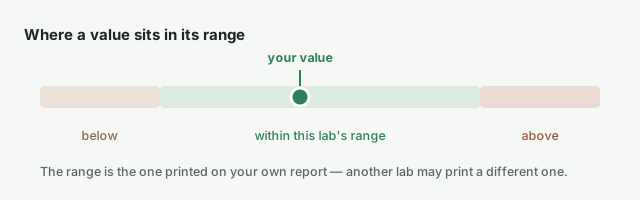
The reference interval — what is on your report
This is the range beside your result. MedlinePlus describes it as "a set of numbers that form the high and low ends of the range of results that's considered to be normal", and says plainly where it comes from: "The ranges are based on the test results from large groups of healthy people."
So it is descriptive. It reports what a laboratory observed in a group it considered healthy, using its own methods. It is not a target, and it is not advice.
MedlinePlus adds the caveat that follows from how it is built: "Because these ranges can vary, the term 'normal' can be misleading."
The cutoff — a threshold that defines something
Some numbers are not observations of a healthy group at all. They are decision thresholds agreed by a professional body: a value at or beyond this point is used to define or diagnose a condition. These come from clinical guidelines rather than from the laboratory that ran your sample, and they can be revised when the guideline is.
A cutoff and a reference interval can disagree on the same page, and neither is wrong — they were constructed to answer different questions.
The "optimal" numbers — the ones that aren't on your report
This is the category you meet online: a narrower band than the reference interval, presented as where a value ought to sit. It has no fixed source. Sometimes it reflects a guideline, sometimes a particular practitioner's preference, sometimes nothing citable at all.
Arkalife does not display these, and this guide does not name any. Deciding what a value ought to be for a particular person is interpretation — a conversation with a doctor, not a number a web page can supply.
Why the distinction matters when reading a report
Because the three drift apart, and a result can be inside one and outside another simultaneously. That is not a contradiction to resolve; it is three questions with three answers.
The practical rule is the one MedlinePlus gives: use the interval printed on your own report, since you "can't compare your results to reference ranges that you might find elsewhere". And keep in mind both halves of its caution — a result outside the range "may or may not be a sign of a health problem", and one inside it "isn't always a guarantee of good health".