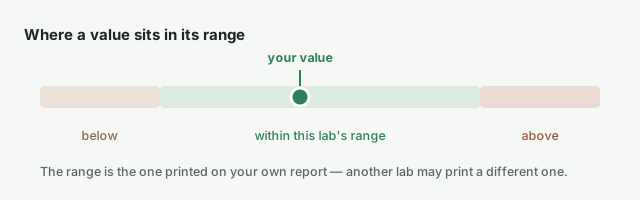
You compare this year's report to last year's, from the same laboratory, and the range beside the result has moved. The value did not change; the boundary did. There are a few ordinary reasons.
The lab changed its method
A reference interval is tied to how the measurement is made. MedlinePlus notes that "because labs often use different testing methods, they often use different reference ranges to describe normal results" — and a single laboratory replacing an analyser or switching assay is the same situation, separated by time rather than by address.
When that happens the interval is re-established for the new method, and the printed range moves with it.
The reference group was revised
Ranges are built "based on the test results from large groups of healthy people". Laboratories periodically rebuild that from a newer or larger group, or adopt one published for the population they serve. The result is a range that shifts slightly without anything about the test changing.
The range depends on something about you
Some intervals are not one range at all. They are a set, selected by age or sex, and the report prints whichever applies. A birthday can therefore move the boundary — most visibly for markers whose intervals are banded by age, where crossing into the next band changes the range while the measured value stays put.
Paediatric reports show this most sharply, since the bands are narrow and change quickly.
Which of these applied to you
The report usually says, if it says anything: a method note in the footnotes, a line naming the assay, or an age band printed alongside the interval. Comparing the two reports side by side is the fastest way to see which column actually moved.
What it means for a trend
The measured values remain comparable to each other. What changed is the line drawn beside them — so a result that was inside the range last year and flagged this year may not have moved at all. This is the same reason a flag is a pointer rather than a verdict.
Keeping the printed range with each individual reading, rather than applying one current range backwards across a history, is what makes that visible. A range is a property of the report it was printed on, and it stays with that reading.